Preface
Why this manifesto
Project Bhulok began as a sequence of forty images and short statements: a slideshow that moves from the vastness of space to the smallest choices of daily life. Here I set out the same sequence in full, expanding each statement into the reasoning behind it and, where useful, the practices it calls for.
I have organised the manifesto in six chapters. The Prologue looks at the Earth as a whole and at what is still missing in us. Two Pillars describes the inner and outer foundations of a complete life. Sustainability offers nine practices for living well within the planet’s limits. Governance outlines the shared institutions of a united world. Pastimes describes the joyful life such a world makes possible. The Epilogue closes with a personal note.
Each section opens with the original statement, set in bold, followed by its expanded explanation. From Chapter 2 onward, each task is assigned an owner — the seat best placed to lead it — shown by the flag to the left of its title: France for culture, law and software; Germany for technology and engineering; Bharat (India) for spirituality and wellbeing; Russia for energy, land and space; Japan for manufacturing and mindful living. Every section also carries a three-dot codon at the right of its title — its essence, mechanism and purpose (what · how · why). A filled dot is positive and a ring is negative. Codons by Inderjit.org. Read in order, the sections form a single argument: that humanity can and should unite now, beginning with each of us, in mind and spirit.
 Chapter 1
Prologue
Earth, its witnesses and the signatures of life, energy and an unfinished mind.

Before any plan for a united planet can be drawn, we must first look at what we are uniting. The Prologue steps back to the widest possible view — the cosmos, the Earth within it, the Sun and Moon that have watched over us — and then narrows to the three signatures by which our planet announces itself: Life, Energy and, still incomplete, Knowledge. It ends with a call: the time to unite is now.
02
Oneness
Faith in all being an integral part of One All-Encompassing Formless Unchanging Omnipotent Omniscient Loving Field residing Eternally at the Highest level that manifests across the realms of creation in diverse forms including within each of us.
At the root of Project Bhulok lies a conviction I hold deeply: that everything which exists is part of one underlying reality. Different traditions have given it different names — Brahman, the Tao, God, the Field — but the experience they point to is the same: a single, loving, conscious ground from which all forms arise and to which they return.
If this is true, then division is an illusion of the surface. The person across a border, across a faith or across a political line is not finally other than us. Oneness is therefore not only a belief to be held but a lens through which every later point of this manifesto should be read: each practice, each institution and each pastime is an attempt to live as though we already are one.
03
Shared Future
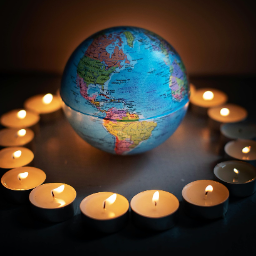
In the vast theater of the cosmos, the Earth emerges as the only known life-supporting entity. Bathed in the gold of a new dawn, its curvature reveals a world without borders.
Seen from orbit, Earth shows no lines between regions. Its oceans flow into one another, its weather crosses every frontier, and its atmosphere is shared by every breathing creature. The borders we fight over are drawn only on our maps.
A shared future begins with accepting this shared present. Whatever happens to one region — drought, pandemic, conflict, collapse — eventually touches all. I propose that we plan accordingly: as one people on one planet, with one future to protect.
04
Watched by the Sun
The radiant giver of life, this celestial sentinel awaits to light up a unified Earth, as an observer who has witnessed ebb and flow of empires, dawn of civilizations, and the countless aspirations of humanity.
The Sun has seen every chapter of the human story. It rose over the first farming villages and the first cities, over the empires that believed they would last forever and the ruins they left behind. To it, our rivalries are brief flickers.
We imagine the Sun as a patient witness, waiting for the day it can rise over a unified Earth. That image is a reminder of scale and of humility: our time is short, and the most meaningful thing we can do with it is to leave the planet more peaceful and more whole than we found it.
05
Nurtured by Moon
A luminous presence in the velvet night has always calmed the tides of the world. It has served as a soft, reflective mirror for humanity, a quiet source of rhythm and light over our collective dreams for eons with its steady, cyclical grace.
Where the Sun is radiant and commanding, the Moon is gentle. It governs the tides, marks our months and seasons, and has guided farmers, sailors and poets for as long as there have been people to look up.
The Moon stands in this manifesto for the quieter virtues — rhythm, reflection, patience and care. A united world will need these as much as it needs energy and ambition; the Moon’s steady cycles remind us that lasting change comes gradually and returns, again and again, to the same calm light.
06
1. Life
Earth’s true identity isn’t just stone and orbit. It’s the vibrant signature of Life. From the deep reaches of space, our rushing rivers, our enormous blue oceans and lush green forests are the first signals that this planet breathes. In a silent observable universe, we are the spectrum of color and vitality.
If another civilisation were to search the sky for signs of life, Earth would announce itself first through colour: the blue of its oceans, the green of its forests, the moving white of its clouds. Life is the planet’s first and deepest signature.
This places a responsibility on us. We are not the owners of that life but one expression of it, and the most capable of protecting it. Every point that follows — from water conservation to animal care — grows from the recognition that life is what makes Earth precious.
07
2. Energy
As the sun sets, Earth reveals its second great signature: Energy. From the silence of orbit, our inter-connected cities glow like a neural network, tracing the pulse of human ingenuity. This golden web is the light of our progress as a civilization.
When night falls across the planet, a second signature appears: the light of our cities, strung together by roads, cables and flight paths into a glowing network that resembles a brain. It is the visible trace of human ingenuity — of energy harnessed, shared and put to work.
This web of light is a genuine achievement, and I celebrate it. But energy is only a capacity. Whether it lights a hospital or powers a weapon depends entirely on the mind that directs it, which brings us to the third — and still incomplete — signature.
08
3. Knowledge?
While our cities glow in space, yet the Human Mind, the most powerful known creation, remains an invisible frequency. It is still maturing, its incompleteness often leading to the bad decisions and suffering we see today. We have the power of gods, but we are still waiting for ample wisdom.
Our technology has outpaced our wisdom. We can split atoms, edit genes and connect billions of people instantly, yet we still struggle to manage anger, greed and fear. The human mind, the most powerful instrument we know of, remains unfinished.
This is why the third signature carries a question mark. Much of the suffering we see today — war, inequality, ecological damage — is not caused by a lack of power but by a lack of maturity in how we use it. I treat the growth of the mind, individually and collectively, as the central work of our age.
09
NOW!
How long will we as victims of our underdeveloped minds suffer from isolation, of being divided? Someone has to unite us all… for the benefit of this planet… this needs to manifest RIGHT NOW!
There is a limit to how long a divided humanity can keep paying the price of its divisions. Every year of delay deepens conflicts, depletes resources and widens the gap between what we are capable of and what we actually achieve.
I therefore insist on urgency. Unity cannot wait for a perfect moment or a perfect leader; someone has to begin, and the time to begin is now. I offer Project Bhulok as that beginning.
10
Project Bhulok
The call of the hour is to unite now… in mind and spirit.
Project Bhulok — from the Sanskrit for the earthly realm — is the name for this effort to unite humanity in mind and spirit. It is not a jurisdiction, a religion or a party, but a shared framework that any person or people can adopt.
In the rest of these pages I set out what that framework contains: the inner and outer pillars of a good life, nine practices of sustainability, the institutions of a united Earth, and the pastimes that make such a world worth living in.
 Chapter 2
Two Pillars
Spiritual completeness and material comfort, held together.

A whole human being stands on two pillars. One is inner: the quiet, steady work of becoming spiritually complete. The other is outer: the honest pursuit of comfort, prosperity and influence. I do not ask us to choose between them. I ask us to hold both, and to let each keep the other honest.
11

Spiritual Completeness
Let us pledge today to mark daily time to quietly meditate… to prioritize inner growth over material progress… to slowly unlearn the habitual patterns that bind us in deep karmic ways, limiting our potential. Let us learn to be free!
Inner growth is the foundation on which everything else rests. Without it, even the best institutions are eventually bent by the same old impulses of fear, greed and anger. With it, ordinary people become steady, generous and free.
The practice suggested here is modest and universal: set aside time every day to sit quietly and meditate. Over months and years this simple discipline loosens the habitual patterns — the karmic grooves — that keep us reacting rather than choosing. Spiritual completeness is not withdrawal from the world but the ability to act in it with clarity.
In practice
- A fixed daily time for silent meditation
- Regular reflection on one’s habits and reactions
- Placing inner growth ahead of material progress when the two conflict
12

Material Comfort
Let’s break the taboo of Earning money, Having sex or Attaining power… as long as we act for the benefit of all. Let us be bold enough to dream… and unafraid of putting in the required hard work.
Many traditions have treated money, sexuality and power as suspect in themselves. I reject that view. These are natural forces, and like any force they can be used well or badly. The test is not whether we pursue them, but whether we pursue them for the benefit of all.
I therefore encourage people to dream boldly — to build businesses, families and institutions — and to do the hard work that such dreams require. Material comfort, honestly earned and wisely shared, is part of a complete human life.
In practice
- Earning openly and ethically
- Relationships grounded in respect and consent
- Power used as service rather than domination
 Chapter 3
Sustainability
Nine practised points for long-term ecological balance.

Material ambition without restraint consumes the very ground it stands on. This chapter sets out nine practices — simple enough for one household, powerful enough when multiplied across billions — that let us enjoy a good life while leaving the planet richer than we found it.
13

Sustainability
But all our demands for material follow moderation and balance to assist us in maintaining long-term ecological sustainability with the following 9 implemented points…
The freedom to pursue comfort comes with a responsibility of moderation. A planet of finite resources cannot sustain unlimited consumption, and every material choice we make draws on soil, water, air and energy that belong to everyone, including generations not yet born.
The nine points that follow translate this responsibility into everyday practice. None of them is difficult on its own; together, adopted widely, they would transform humanity’s relationship with the Earth.
14

1. Water Conservation
We drink water. It is life and we treat it as a precious resource. We use minimal water for washing, bathing and industrial purposes. We close the tap while shaving… and opt more for the shower than the bathtub.
Water is life in its most literal form. Yet a large share of the world’s fresh water is wasted through careless habits at home and inefficient processes in industry, while many communities still lack enough of it to drink.
Conservation begins with small, repeatable choices and scales up to how farms and factories are run. Treating water as precious is both an ecological necessity and an act of solidarity with those who have too little.
In practice
- Close the tap while shaving or brushing teeth
- Prefer short showers to full baths
- Reuse and recycle water in industry and agriculture
15
2. Biodegradables
We keep our lands and oceans clean by opting for modern biodegradable alternatives as materials for packaging and carrying.
Plastics and other persistent materials have spread to every corner of the Earth, from mountain tops to the deepest ocean trenches. Much of it comes from packaging used for minutes and then discarded for centuries.
Modern biodegradable alternatives — paper, plant-based films, natural fibres, reusable containers — make it possible to carry and package goods without leaving that legacy behind. Choosing them is one of the simplest ways to keep land and sea clean.
In practice
- Carry reusable bags and containers
- Choose biodegradable packaging as a buyer and as a business
- Support local systems for composting and recycling
16
3. More Trees
Trees are responsible for enriching the atmosphere with the Oxygen that our cells consume when we breathe. We reverse the undesirable side-effects of modern industrialization by essentially planting more trees.
Trees are the lungs of the planet. They produce the oxygen our cells consume, store carbon, cool the air, hold soil together and shelter countless other species.
Industrialisation has cleared forests faster than they can recover. Planting trees — in cities, along roads, on farmland and in degraded land — is a direct and visible way to reverse that damage, and one in which every person can take part.
In practice
- Plant and care for trees locally
- Protect existing forests from clearance
- Support reforestation on a large scale
17
4. Ecofriendly Commute
We choose Electric or purely Mechanically-driven vehicles over Fuel-driven ones. This not only keeps the air cleaner but also limits our dependence on fossil fuels.
Transport is one of the largest sources of air pollution and fossil-fuel use. Every journey made by a fuel-burning engine adds to both.
Electric vehicles and purely human-powered ones — bicycles, walking, rowing — offer cleaner alternatives. Choosing them improves the air we breathe today and reduces our dependence on fuels that are finite and often the cause of conflict.
In practice
- Walk or cycle for short journeys
- Choose electric vehicles and public transport
- Plan cities around clean mobility
18

5. Renewable Energy
We install Solar and other renewable energy sources in our own premises that enable us to not only meet our own requirements but also feed the grid back during relatively idle hours of residential electrical activity.
The Sun delivers more energy to the Earth every hour than humanity uses in a year. Solar panels, small wind turbines and other renewable sources allow households and businesses to capture a share of it where they live and work.
Producing energy locally makes communities more resilient, and feeding surplus power back into the grid during quieter hours helps everyone. Each home becomes not only a consumer but a contributor.
In practice
- Install solar or other renewables on one’s own premises
- Feed surplus energy back to the grid
- Use energy-efficient appliances and buildings
19
6. Minimalism
While sky is the limit for our material dreams, we choose to consciously live a life of minimum wants to help conserve the planet’s resources which serve us. All our body-related belongings pack within 1 suitcase.
Our dreams may be limitless, but our needs are not. Minimalism is the conscious choice to live with what is enough, so that the planet’s resources can serve everyone.
I offer a vivid benchmark: all of a person’s body-related belongings should fit in a single suitcase. Few will meet it immediately, but it is a powerful reminder of how little we need — and of the freedom that comes from owning less.
In practice
- Buy less and choose better
- Repair, share and pass things on
- Measure personal belongings against the one-suitcase ideal
20
7. Family Planning
We start a small family but also a joint family. We take care not only of our kids but also our old parents.
A sustainable world needs a balanced population and strong families. I recommend small families, so that each child can be given full care and the planet is not over-burdened.
At the same time, I value the joint family: generations living close to one another and caring for one another. Children are raised with the wisdom of grandparents, and elderly parents are looked after with love rather than left alone.
In practice
- Plan for a small number of children
- Keep generations close and connected
- Care for elderly parents as part of family life
21
8. Vegetarianism
We eat a Healthy Sattvic diet of fruits, vegetables, whole grains, legumes, milk, honey and nuts. We abstain from alcohol, smoking and addictive substances. We exercise moderation in food and drink.
Food shapes the body, the mind and the planet. A sattvic diet — fruits, vegetables, whole grains, legumes, milk, honey and nuts — is light, nourishing and far less demanding on land and water than diets built on meat.
I also ask us to abstain from alcohol, smoking and addictive substances, and to practise moderation in all eating and drinking. Health, clarity of mind and care for the Earth are served by the same choices.
In practice
- Base meals on plants, grains and dairy
- Avoid alcohol, tobacco and addictive substances
- Eat and drink in moderation
22
9. Peace & Brotherhood
We keep check on our temper, stay calm, interact gently with manners respecting everyone equally. We be the best versions of ourselves in our home, office, surroundings as well as socially including online.
Sustainability is not only about resources; it is also about how we treat each other. Anger, rudeness and contempt deplete communities just as surely as pollution depletes the land.
The ninth point asks each of us to keep our temper in check, to speak gently, to respect everyone equally and to be the best version of ourselves at home, at work, in public and online. Peace between regions begins with peace between people.
In practice
- Pause before reacting in anger
- Treat every person with equal respect
- Carry the same courtesy into online spaces
 Chapter 4
Governance
One planet, one rule book, one shared safety net.

Personal change becomes lasting only when the structures around us support it. This chapter describes the shared framework a united Earth would need: common governance, secure food, open passage, one peace-keeping force, a common currency, one humane rule book, a dependable safety net and the freedom to speak.
23
Global Governance
We improve upon current global frameworks with something more efficient at bringing lasting peace, stable operations and sustainable progress to mankind.
Today’s global institutions were built for a different century and often struggle to act quickly or fairly. I propose improving on them with a framework designed from the outset for a united planet.
Its goals are simple to state: lasting peace, stable operations and sustainable progress for all of humanity. The points that follow describe what such a framework would provide in practice.
24
Food Security
We build localized and zonal storage capacity and distribution capability for even and consistent supply of food grains as well as perishable food at affordable rates.
Hunger persists not because the world grows too little food but because food is unevenly stored and distributed. Harvests rot in one place while shortages strike another.
Local and regional storage and distribution networks would smooth out these gaps, ensuring a steady supply of grains and fresh produce at affordable prices everywhere. Food security is the most basic promise a united Earth can make.
In practice
- Build local and zonal storage capacity
- Strengthen distribution for grains and perishables
- Keep staple food affordable for all
25
Freedom to Navigate
We collectively agree upon providing universal unconditional access to our lands, waters and airspace to any civilized party looking to traverse via it.
Borders today restrict not only people but trade, travel and cooperation. In a united world, passage across land, sea and air should be a right rather than a privilege.
I propose universal, unconditional access for any civilised party wishing to pass through. Open passage builds trust, lowers costs and turns the planet into one shared home.
26
Unified Military
We unite our military forces into one single voluntary peace-keeping force to manage crisis situations like natural calamities.
Much of humanity’s wealth is spent preparing for war against itself. A united Earth would have no need for rival armies.
Instead, I propose a single, voluntary peace-keeping force, trained and ready to respond to natural disasters and other crises wherever they occur. Its purpose would be protection and relief, not conquest.
27
One Universal Currency
While maintaining our local currency as our primary means of exchange, we use GO£D as the universal secondary currency across the globe, especially as a common foreign exchange denomination.
Local currencies reflect local economies and should be kept. But trade between regions is complicated and often destabilised by fluctuating exchange rates.
I propose GO£D as a universal secondary currency — a common denomination for cross-regional exchange that sits alongside, rather than replaces, each region’s own money.
28
One Set of Guidelines
We follow one rule book for the entire dominion of Earth, softer than previous laws; guidelines that treat human as an inherently good but mistake-prone ‘fallen’ learner rather than a condemnable sinner.
A united Earth needs one set of guidelines that apply to everyone. These would be gentler than many existing laws, built not on punishment but on growth.
At their heart is a different view of human nature: people are fundamentally good but prone to mistakes — “fallen” learners rather than sinners to be condemned. Guidelines written in that spirit aim to correct, educate and restore.
29
Guaranteed Social Care
We get a handy stipend in college to support higher education, unemployment benefits, a reasonable pension once retired and a lifelong partial support for healthcare irrespective of our class.
A dependable safety net frees people to take risks, learn and contribute. I outline one that would be available to everyone, regardless of class.
It includes a stipend for students in higher education, support during unemployment, a reasonable pension in retirement and lifelong partial support for healthcare. Security at each stage of life is the foundation of a confident, creative society.
In practice
- Stipends for higher education
- Unemployment benefits
- Pensions in retirement
- Lifelong partial healthcare support
30
Freedom of Speech
We have total freedom of speech, written word and thought to publicly criticize and mock any person or policy including people in position of power in whatever taste we deem fit, not amounting to personal threats, calls to hurt or cause harassment.
Free speech is how a society corrects its own mistakes. I stand for complete freedom to speak, write and think — including the freedom to criticise and mock anyone, however powerful.
That freedom has one clear limit: it does not extend to personal threats, calls to harm or harassment. Within that limit, open debate, satire and dissent are welcomed as signs of a healthy world.
 Chapter 5
Pastimes
Living lightly: music, sport, art, animals, technology and space.

A united world is not merely a well-managed one; it must also be worth living in. The Pastimes chapter describes the joyful use of freedom — music, sport, art, animals, technology, intelligence, biology and, finally, the stars — as the natural expression of a life lived lightly and well.
31
Earth Life is Beautiful
We live life lightly at our own terms and pace. Do not rush and find the time to smell the rose… savoring each moment as it comes… as we enjoy our favorite pastimes…
Having described the structures of a united world, I turn to its purpose: a life worth living. That life is lived lightly, on one’s own terms and at one’s own pace.
It means slowing down enough to notice beauty — to stop and smell the rose — and giving time to the pastimes that bring us joy. The sections that follow describe some of them.
32
Music as a Pastime
We cherish our connection to music, whether we listen to or play an instrument or sing… or even bee-bop.
Music is one of humanity’s oldest and most universal languages. It needs no translation and crosses every border.
Whether we listen, play an instrument, sing or dance, music connects us to ourselves and to one another. I treat it as an essential part of a balanced life.
33
Sports as a Pastime
We limit our screen time by choosing to pursue outdoor sports that we love to play, not just watch… and that is how we bond and gel with others… not over social media but in person.
Screens increasingly take the place of real activity and real company. I encourage each of us to limit screen time and play the sports we love, rather than only watching them.
Sport keeps the body healthy and builds friendships in person, not through social media. Shared play is one of the simplest ways for people of any background to come together.
34
Art as a Pastime
We take creative liberty when we bring out our talents to manifest in reality what has been in our thoughts and dreams… whether it be painting, crafts, stand up comedy, graphic design, poetry or an exotic interest.
Every person carries ideas and dreams that want to take form. Art is how we give them shape — through painting, crafts, stand-up comedy, graphic design, poetry or any other creative pursuit.
I encourage everyone to take creative liberty. A world that makes room for art is a world that values the inner life of each of its people.
35
Animals as Pastime
Not only do we love keeping pets at home… but we equally care for animals in sanctuaries and we help in their conservation by boycotting any goods or services that come at the expense of wildlife.
Our love for animals begins with the pets we keep at home, but it should not end there. Animals in sanctuaries and in the wild deserve the same care.
I ask each of us to support their conservation actively, including by refusing goods and services that come at the expense of wildlife. Caring for animals is one more expression of our respect for life.
36
Technology as a Pastime
Not only are our Earth pastimes limited to leisure activities… but we also foray into fields that one may label as ‘work’. Innovation of new tech continuously balances the enjoyment of current ones so that there never is a feeling of stagnation.
Pastimes are not limited to leisure. Many people find their deepest enjoyment in work — in building, inventing and solving problems.
Technology is one such field. Continuous innovation keeps life fresh: as we enjoy what exists, we also create what comes next, so that there is never a sense of stagnation.
37
Intelligence, a Pastime
We research and improve upon AI with a new concept called RI (Real Intelligence). If AI is about learning patterns… RI is about mastering the design paradigm of the universe.
Artificial intelligence has shown how much can be learned from patterns in data. I propose a further step, which I call Real Intelligence (RI).
If AI is about learning patterns, RI is about understanding the design principles of the universe itself. Pursuing it is both a scientific and a spiritual adventure — and one of the most exciting pastimes a united humanity could share.
38
Biology, a Pastime
We figure out new things about the human body to increase productive lifespan and health quality so that a person can achieve more in their life time… and we consider both: Traditional Yoga as well as Medicine.
Understanding the human body allows us to live longer, healthier and more productive lives, giving each person more time to achieve what they hope to.
I value both traditional wisdom, such as yoga, and modern medicine. Used together, they offer a fuller picture of health than either can alone.
39
Space Exploration
Our collective pastime is to fire rockets into space to find new worlds. We look to expand the existing scope of our activities and knowledge once we mingle with other civilizations across the galaxy to learn about the pastimes in their culture… and what they know.
The final pastime is the greatest adventure of all: exploring space. Launching rockets in search of new worlds expands the reach of human activity and knowledge.
I imagine a time when humanity meets other civilisations across the galaxy and learns from their cultures, pastimes and knowledge. A united Earth would be ready to meet them as one.
 Chapter 6
Epilogue
A closing note from me.

I close with a personal note, dated 1 April 2026 — the day I chose to launch all of this, in full seriousness and with a knowing smile.
40
Live Now, April 1 2026
Earth Life is a cosmic joke… though even if this is a prank… rest assured it shall be the biggest, most elaborate one ever played out on this planet… for what is this but a game… and my favorite pastime.
Why the first of April? I’ll let you decide. Some jokes are told; others are lived — and the best ones end with everyone in on it.
Yours truly,
Tushar Sikand (LogicHulk)
Afterword
Where to begin
A manifesto of this scope can feel distant from ordinary life. Yet almost every point in it begins with something a single person can do today: sit quietly for a few minutes, close a tap, plant a tree, choose a bicycle, speak gently, put down the screen and pick up an instrument.
Institutions follow people. When enough individuals live by these principles, families, communities and administrative regions begin to reflect them. To make that happen deliberately rather than by chance, I see the work unfolding in three stages: first within each administrative region, then between the five seats, and finally across the whole world.
I
At home: the regional level
Each seat begins with itself. Before asking anything of the world, a seat puts the manifesto into practice within its own borders — among its own people, through its own institutions and in its own daily life. What cannot work at home will not convince anyone abroad.
At this stage every seat takes the lead on the tasks it owns, drawing on what it does best, while still adopting the full set of forty points for its own citizens. Regional pilots, local champions and clear, published measures of progress turn the manifesto from an idea into lived results that others can see and test.
In practice
- Adopt the manifesto’s practices in households, schools, workplaces and public bodies
- Run regional pilots for the tasks the seat owns and publish what is learned
- Align local rules and policies with the shared set of guidelines
- Track simple, public measures — water saved, trees planted, energy produced, lives supported
II
Together: the seats as one bridge
Once each seat has proven the framework at home, the five begin to work as one. The common bridge between them is economic: trade, finance and investment give administrative regions a practical, everyday reason to cooperate, and every successful exchange builds the trust on which deeper unity depends.
The seats open their markets to one another, settle exchange in a common denomination such as GO£D alongside their own currencies, and pool their strengths through joint ventures. France contributes culture, law and software; Germany its technology and engineering; Bharat (India) its spirituality and wellbeing; Russia its energy, land and reach into space; Japan its manufacturing and mindful craft. Each seat’s owned tasks become a service it offers to the other four.
Beyond trade, the seats share standards, research, education and culture: students and workers move freely between them, scientists collaborate on intelligence, biology and space, and citizens meet through music, sport and art. The economy is the bridge, but the destination is friendship.
In practice
- Preferential trade and investment between the five seats
- Settlement in GO£D as a common secondary currency
- Joint ventures built around each seat’s owned expertise
- Shared standards for sustainability, social care and open passage
- Exchange programmes for students, researchers, artists and athletes
The first collaboration
RIFI · rifilok.org
RIFI is the first collaboration launched under Project Bhulok and the first working example of the second stage. It aims to facilitate trade and exchange between the seats — connecting businesses, easing the movement of goods and capital, and building the practical economic ties on which wider cooperation can grow.
RIFI shows the pattern I hope every later collaboration will follow: start with a concrete, mutually beneficial exchange; prove that it works; then widen it to more partners. More details are available at rifilok.org.
III
Across the world: the global level
With the framework proven at home and between the seats, the five governments together carry it to the rest of the world. Their combined support — diplomatic, economic and practical — gives the project the weight to move from a partnership of five to a framework for all.
At this stage the shared institutions described in Chapter 4 come into being: a global governance framework, food security networks, open passage, a single voluntary peace-keeping force, a common secondary currency, one humane set of guidelines and a guaranteed safety net. Any administrative region willing to adopt the manifesto is invited to join, on equal terms.
In practice
- An open invitation for every administrative region to adopt the framework and join the seats
- Joint backing of the five governments for shared global institutions
- Gradual handover from the seats to institutions that represent all of humanity
Self, then seats, then the world: each stage rests on the one before it. None of it requires waiting for permission. It begins with each of us, today — and when enough of us begin, a united Earth stops being a distant ideal and becomes simply the way we live.
 Back to